This article is part of the Arvora reading room: slower, clearer essays for founders and business owners who want digital decisions to feel less noisy.
The Algarve has become one of Europe's most attractive regions for entrepreneurs. With over 300 days of sunshine, a growing international community, excellent quality of life, and business-friendly policies, it's no surprise that thousands of expats — particularly from the UK, Germany, France, and the Netherlands — are choosing southern Portugal as the place to launch their next venture.
Whether you're opening a hospitality business, launching a digital agency, building a consultancy, or setting up an e-commerce brand, this guide covers everything you need to know about starting a business in the Algarve in 2026.
If you already need the commercial page for the website side of that launch, see Startup Website for New Businesses in Portugal.
Why the Algarve? The Business Case
The Algarve isn't just beaches and golf courses. It's a region undergoing a quiet economic transformation:
- Tourism drives demand. The Algarve receives over 4 million visitors annually, creating year-round demand for services, hospitality, food, and experiences.
- The expat community is thriving. There are over 100,000 foreign residents in the Algarve, many of whom need services in English — from accountants and lawyers to web designers and personal trainers.
- Portugal's NHR tax regime (now the Incentivised Tax Status for new applicants) can still offer favourable tax treatment for certain professions and foreign-source income.
- Cost of living remains competitive compared to the UK, Ireland, the Netherlands, and Scandinavia — especially for office space, co-working, and local hires.
- Digital infrastructure is solid. Fibre broadband coverage across the Algarve has expanded rapidly, making remote work and digital businesses entirely viable.
The combination of lifestyle, low operational costs, and a growing customer base makes the Algarve one of the best places in Europe to start a small business in 2026.
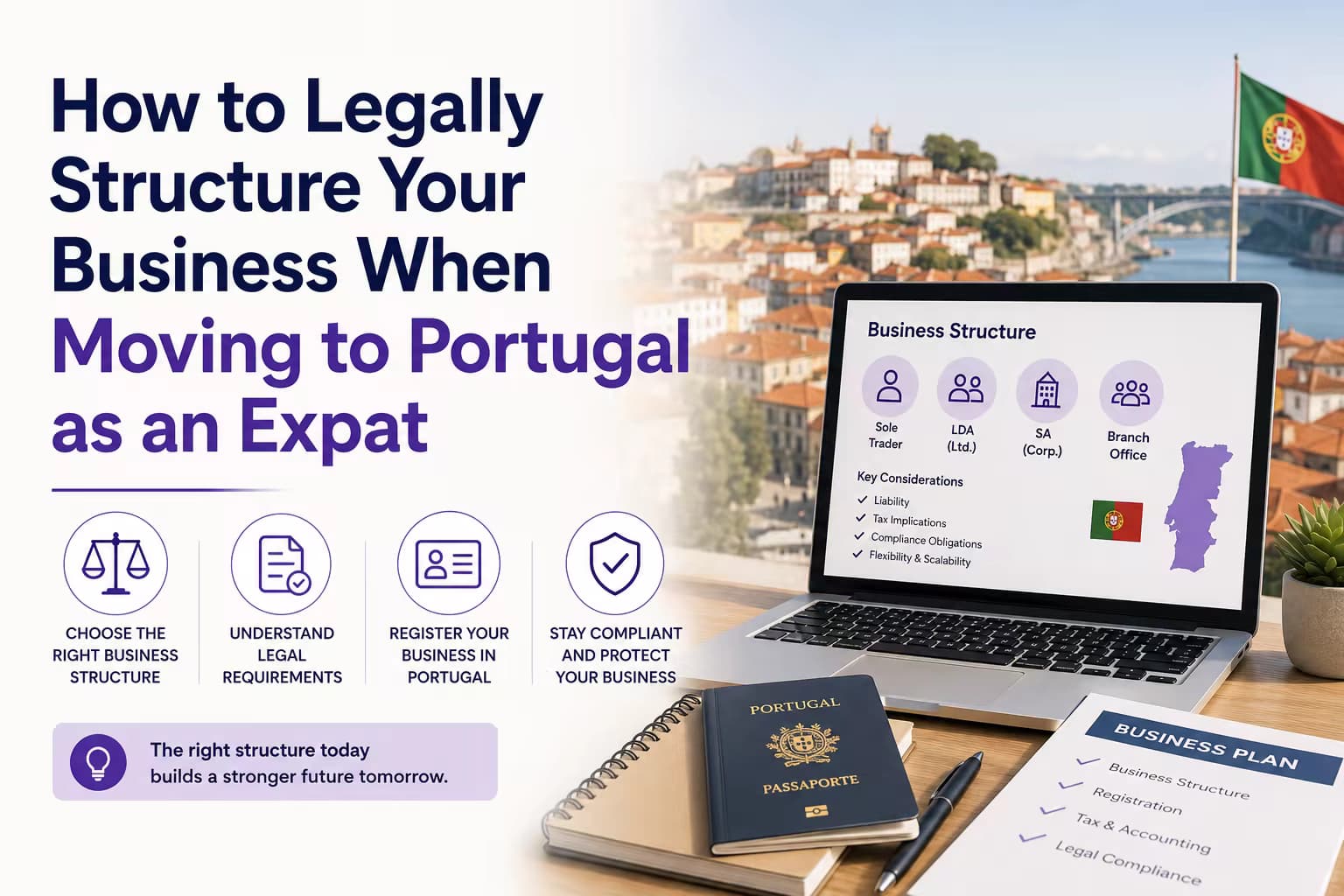
Step 1: Choose Your Legal Entity
Before anything else, you need to decide how your business will be structured. Portugal offers several entity types:
Empresario em Nome Individual (Sole Trader)
The simplest option. You operate under your own name with no separation between personal and business assets. Good for freelancers and consultants just starting out.
Pros: Minimal setup, low cost, simplified accounting. Cons: Unlimited personal liability, harder to scale.
Sociedade Unipessoal por Quotas (Unipessoal Lda)
A single-member limited company. This is the most popular choice for solo entrepreneurs because it provides limited liability while keeping things relatively simple.
Pros: Limited liability, professional image, easier to open business bank accounts. Cons: Requires a minimum social capital (as low as €1, though €5,000+ is recommended for credibility), mandatory annual accounts.
Sociedade por Quotas (Lda)
A multi-member limited company, similar to a UK Ltd. Required if you have two or more partners.
Pros: Shared ownership, limited liability, flexible profit distribution. Cons: More complex governance, requires articles of association.
Which should you choose?
For most expat entrepreneurs starting a service-based business, the Unipessoal Lda strikes the best balance between simplicity and protection. If you're a freelancer testing the waters, start as a sole trader and incorporate later.
Tip: Always consult a Portuguese accountant (contabilista certificado) before incorporating. They'll advise on the best structure for your specific situation and handle the registration.
Step 2: Get Your NIF (Tax Number)
Your NIF (Numero de Identificacao Fiscal) is the single most important number in Portuguese life. You need it for everything — opening a bank account, signing a lease, registering a company, and filing taxes.
How to get your NIF:
- Visit your local Financas office (tax office) with your passport and proof of Portuguese address. If you don't have a Portuguese address yet, you can appoint a fiscal representative.
- Bring a fiscal representative if you're a non-EU citizen or don't yet have a Portuguese address. Many accountants and law firms offer this service for €100–300/year.
- Wait time: Usually same-day issuance.
If you're still outside Portugal, some services allow you to obtain a NIF remotely through a fiscal representative — useful for getting set up before you arrive.
Step 3: The D2 Visa (Entrepreneur Visa)
If you're a non-EU citizen, the D2 visa is your gateway to starting a business in Portugal. It's designed for entrepreneurs who want to establish or invest in a business.
Requirements:
- A detailed business plan demonstrating viability
- Proof of financial means to support yourself (typically 12 months of living expenses)
- A clean criminal record
- Health insurance valid in Portugal
- Evidence that you've already started the company formation process (NIF, company registration)
- Investment proof — evidence you're committing capital to the Portuguese economy
Process:
- Apply at the Portuguese consulate in your country of residence
- Receive the D2 visa (typically valid for 4 months)
- Enter Portugal and apply for a residence permit at AIMA (the migration agency, formerly SEF)
- Residence permit is renewable, leading to permanent residency after 5 years
Timeline:
The D2 visa application typically takes 2–4 months. Processing times at AIMA for the residence permit can take 3–8 months, though you can work legally while your application is pending.
For UK citizens post-Brexit: You no longer have automatic right to establish a business in Portugal. The D2 visa is the standard route.
Step 4: Open a Business Bank Account
Once you have your NIF and company registration, you'll need a Portuguese business bank account. The major banks include:
- Millennium BCP — Largest private bank, English-speaking staff in Algarve branches
- Novo Banco — Competitive business accounts
- ActivoBank — Digital-first, lower fees
- Wise Business — Not a Portuguese bank, but widely used by expat entrepreneurs for multi-currency transactions
What you'll need:
- Company registration certificate (Certidao Permanente)
- NIF of the company and directors
- Identification documents
- Proof of address
- Company articles of association
Expect the process to take 1–3 weeks. Some banks require an in-person meeting; others allow partial digital onboarding.
Step 5: Register with Social Security
All business owners in Portugal must register with Social Security (Seguranca Social) and pay monthly contributions. For the first 12 months, new sole traders are exempt from contributions. After that, the rate is approximately 21.4% of declared income.
For Lda directors, contributions are fixed based on the IAS (Indexante dos Apoios Sociais) and are around €200–350/month.
Your accountant will handle the registration process and monthly declarations.
Step 6: Set Up Your Accounting
Portuguese tax law requires all businesses to have a certified accountant (contabilista certificado). This isn't optional — it's a legal requirement for limited companies.
A good accountant will:
- Handle your VAT returns (quarterly or monthly)
- File your annual corporate tax return (IRC)
- Manage social security declarations
- Advise on tax-efficient structures
- Issue certified invoices
Cost: Expect to pay €80–200/month for a small business. English-speaking accountants in the Algarve charge slightly more but are worth it for the communication clarity.
Step 7: Build Your Digital Presence
In 2026, your digital presence is your first impression. Before you hand out a single business card, potential clients will search for you online. Here's what you need:
A professional website
A fast, mobile-first, SEO-optimised website is non-negotiable. It should clearly communicate:
- What you do and who you serve
- Your value proposition (why you, not your competitor)
- How to get in touch
- Social proof (testimonials, case studies, portfolio)
If you're targeting both Portuguese and international clients, consider a bilingual website with proper hreflang tags so Google knows which version to show each audience.
At Arvora, we build high-performance websites for businesses in the Algarve — designed to convert visitors into clients.
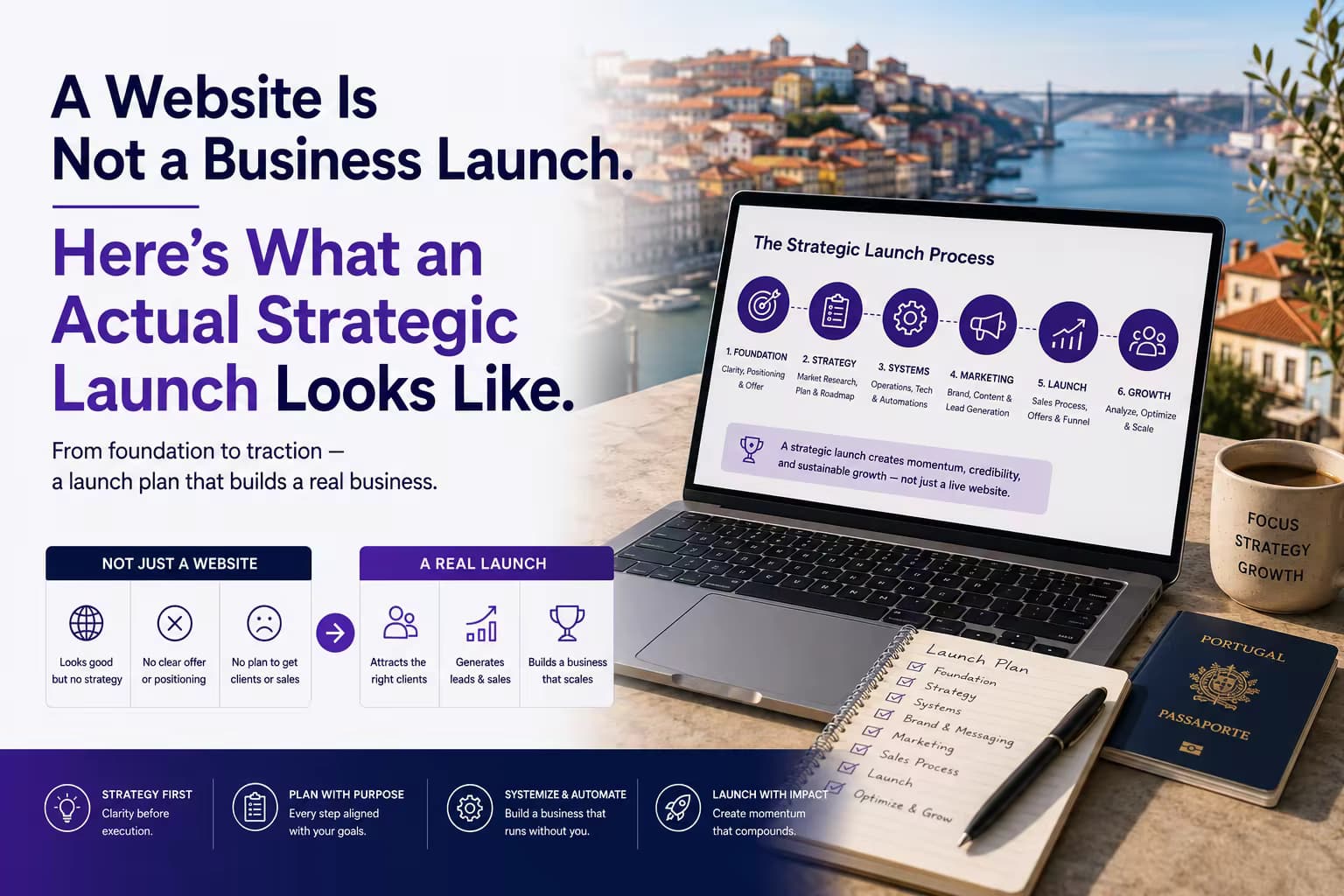
For founders who need a clearer first launch site rather than a heavy platform immediately, see Startup Website for New Businesses in Portugal.
Google Business Profile
Claim and optimise your Google Business Profile. This is free and critical for local search visibility. Include:
- Accurate business name, address, and phone number (NAP)
- Business hours
- High-quality photos
- Service descriptions
- Regular posts and updates
Social media foundations
At minimum, set up:
- Instagram — Essential for hospitality, lifestyle, and visual businesses
- LinkedIn — Critical for B2B, consulting, and professional services
- Facebook — Still important in Portugal, especially for reaching the local Portuguese market
Don't try to be everywhere at once. Choose 1–2 platforms and be consistent.
Step 8: Find Your First Clients
The Algarve business community is smaller and more connected than you might think. Word of mouth travels fast — both good and bad. Here's how to build your pipeline:
Networking
- Algarve Business Network (BNI) — Weekly referral groups across the region
- Expat Facebook groups — "Expats in the Algarve", "British Expats Portugal", and niche industry groups
- Co-working spaces — Hub offices in Faro, Lagos, and Portimao host regular events
- Chamber of Commerce events — CCIP (British-Portuguese) and AmCham host regular mixers
Referral partnerships
Partner with complementary businesses. If you're a web designer, partner with accountants, lawyers, and marketing consultants who serve the same clientele. Cross-referrals are the lifeblood of small business in the Algarve.
Online directories and listings
Register your business on key platforms:
- Google Business Profile — The single most important local listing
- Paginas Amarelas (Yellow Pages Portugal) — Still relevant for local Portuguese searches
- TripAdvisor / TheFork — Essential for hospitality and food businesses
- Clutch / DesignRush — For digital agencies and tech service providers
- Algarve Daily News and local publication directories
Content marketing
Publishing helpful content — blog posts, guides, social media tips — positions you as an authority and drives organic traffic to your website. This is a long-term strategy that compounds over time. A single well-researched article can drive hundreds of visits per month for years.
Read more about our process for building digital systems that attract clients.
Step 9: Understand Your Tax Obligations
Key taxes for businesses in Portugal:
| Tax | Rate | Notes |
|---|---|---|
| IRC (Corporate Tax) | 21% (mainland) | Reduced 17% rate on first €50,000 for small businesses |
| IVA (VAT) | 23% standard | Reduced rates of 6% and 13% for certain goods/services |
| IRS (Personal Income Tax) | 14.5%–48% progressive | On salary drawn from the company |
| Social Security | ~23.75% employer + ~11% employee | Mandatory for all employees |
| Stamp Duty (Imposto de Selo) | 0.4%–0.8% | On certain contracts and financial transactions |
Key deadlines:
- Monthly: VAT declaration (by the 10th of the following month)
- Quarterly: Advance corporate tax payments
- Annual: Corporate tax return (May), IRS declaration (April–June)
Your accountant handles all of this, but understanding the basics helps you plan cash flow.
Step 10: Plan for Insurance and Legal Protection
Running a business in Portugal without proper insurance is a risk you don't need to take. Key policies to consider:
- Professional liability insurance (Seguro de Responsabilidade Civil Profissional) — essential for consultants, designers, and anyone providing advice or services.
- Commercial property insurance — if you have an office or retail space.
- Workers' compensation (Seguro de Acidentes de Trabalho) — mandatory if you hire employees, even part-time.
- Vehicle insurance — if using a vehicle for business purposes.
For service-based businesses, professional liability insurance typically costs €200–600/year. It's a small price for significant protection against claims.
Additionally, consider having a lawyer review your client contracts, terms of service, and any partnership agreements. Portuguese contract law has some nuances that differ from UK or US common law systems.
Common Mistakes to Avoid
After working with dozens of entrepreneurs setting up in the Algarve, here are the most common pitfalls:
- Skipping the accountant. Don't try to navigate Portuguese tax law alone. The penalties for mistakes are significant.
- Underestimating bureaucracy. Portugal's administrative processes take time. Start your company registration, NIF, and bank account setup months before you need to trade.
- Neglecting your digital presence. "I'll build the website later" means losing clients to competitors who already have one.
- Pricing too low. Many expats undercut on price to win initial clients. This sets a ceiling you'll struggle to raise.
- Not learning basic Portuguese. You don't need to be fluent, but "bom dia" and "obrigado" go a long way. Many government offices and local suppliers only speak Portuguese.
- Ignoring the seasonal rhythm. The Algarve has a distinct high season (June–September) and low season. Plan your cash flow accordingly.
How Arvora Can Help
Starting a business is exciting — and overwhelming. The last thing you need is to spend weeks wrestling with website builders, logo generators, and social media algorithms.
That's where we come in. Arvora is a digital agency based here in the Algarve. We build:
- High-performance websites that rank on Google and convert visitors into clients
- Brand identities that communicate professionalism and trust from day one
- AI automations that save you hours on repetitive tasks
- Ongoing support so you're never alone after launch
We work in English and Portuguese, understand the local market, and know what it takes to stand out in the Algarve's growing business landscape.
Ready to get started? Get in touch — we'd love to hear about your project.
Frequently Asked Questions
How much does it cost to start a business in the Algarve?
Budget approximately €2,000–5,000 for the basics: company formation (€360–500), accountant setup, NIF, bank account, and initial professional services. A professional website adds €1,500–5,000+ depending on complexity.
Can I run a business from home in Portugal?
Yes, many service-based businesses operate from home. You'll need to check your rental or property agreement for any restrictions, and your address will be listed publicly in the company registry.
Do I need to speak Portuguese to start a business?
Not necessarily — especially if your clients are international. But having a Portuguese-speaking accountant and basic conversational Portuguese will make government interactions much smoother.
How long does it take to register a company in Portugal?
A Lda or Unipessoal Lda can be registered in as little as 1 hour through the "Empresa na Hora" (Company in an Hour) programme at registered offices. The full process including NIF, bank account, and social security typically takes 2–4 weeks.
Is the Algarve a good place for digital nomads?
Absolutely. The Algarve offers excellent internet connectivity, a growing co-working scene, favourable time zone (GMT/GMT+1), and one of the best climates in Europe. The D8 Digital Nomad Visa provides a legal framework for remote workers.
This guide was written by the team at Arvora — a digital agency in the Algarve helping entrepreneurs build their online presence from day one. Last updated April 2026.
About the author

Moxci
Personal Coach & Growth Partner, Arvora
Moxci brings calm strategic clarity to Arvora client relationships, helping founders and businesses see the bigger picture, make better decisions, and move through growth with focus instead of noise.
Meet the team