This article is part of the Arvora reading room: slower, clearer essays for founders and business owners who want digital decisions to feel less noisy.
Moving to Portugal to launch a business is one of the most strategic decisions a founder can make in 2026. Between the lifestyle, the tax incentives, and the growing international client base, the case is compelling.
But getting the legal structure right from day one is not a bureaucratic formality. It is the first commercial decision that shapes your tax exposure, liability, banking access, and how clients and partners perceive your operation.
This guide covers the core options, the key questions to answer before you choose, and what to put in place digitally so your business looks credible from the moment the paperwork is signed.
The Three Structures Most Expat Founders Consider
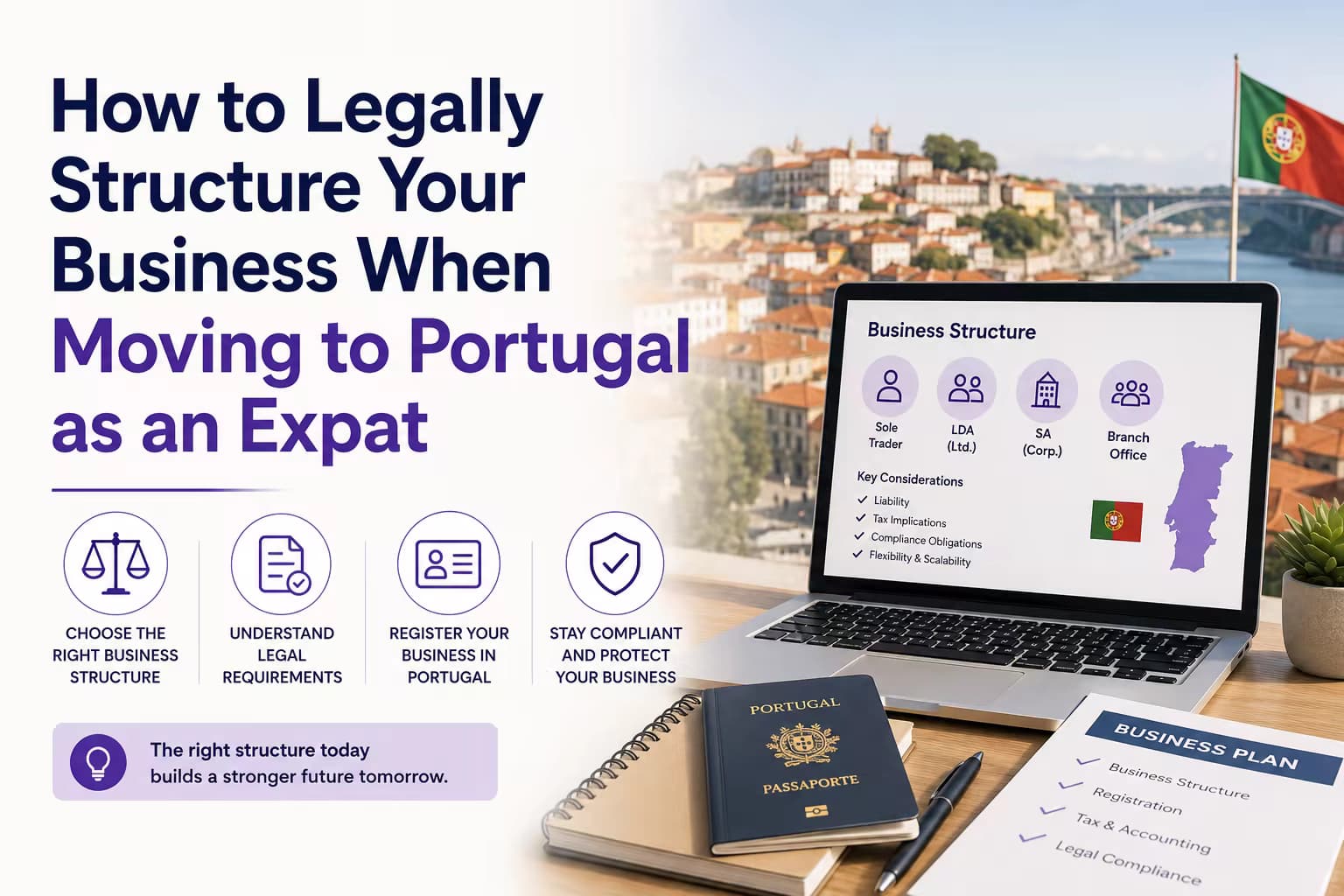
1. Empresário em Nome Individual (ENI) — Sole Trader
This is the simplest route. You operate as an individual, register your NIF, and begin trading under your own name. There is no separate legal entity — the business and you are the same thing.
Good fit for: Freelancers, consultants, coaches, and service providers with low operating costs and minimal liability exposure.
Tax note: Under the simplified regime, 75% of professional service income is taxable. For new residents qualifying under Portugal's Incentivised Tax Status (the successor to NHR), some foreign-source income may be treated favourably — but this depends on your specific situation and should be confirmed with a local accountant.
Limitation: Unlimited personal liability. If the business owes money, so do you personally.
2. Sociedade por Quotas (Lda) — Private Limited Company
This is the Portuguese equivalent of a UK Ltd or a German GmbH. You create a separate legal entity with its own tax number (NIPC), its own bank account, and limited liability for shareholders.
Good fit for: Founders expecting consistent revenue, those working with corporate clients who require invoices from a registered company, service businesses that will eventually hire, and anyone planning to scale.
Minimum share capital: €1 (in practice, €5,000 is often recommended for credibility and banking purposes).
Tax rate: IRC (corporate income tax) currently at 20% for the first €50,000 profit for SMEs, 21% above that. There are municipal surcharges (derrama) that vary by location.
Key advantage: A properly formed Lda signals permanence. To premium clients, it signals that you are not a freelancer — you are a company.
3. Unipessoal Lda — Single-Member Ltd
This is a Lda with one shareholder. You get the limited liability protection and corporate structure of an Lda, but you are the sole owner. It is the most common structure for expat founders launching independently.
Good fit for: Solo founders who want a professional entity without the complexity of multiple shareholders.
Questions to Answer Before You Choose
1. Who are your clients? If you are selling to consumers or individuals, an ENI may be sufficient. If you are selling to businesses — especially international ones — a Lda or Unipessoal Lda presents more credibly and may be required for certain procurement processes.
2. What is your expected revenue in year one? At lower revenue levels, the simplified ENI regime can be more tax-efficient. At higher revenue, the IRC corporate rate often wins. This calculation is very individual — run it with a Portuguese accountant before deciding.
3. Are you bringing capital or assets into Portugal? If you are relocating business assets, transferring investments, or bringing in overseas income, the structure you choose affects how those transactions are treated. A tax advisor who specialises in cross-border cases is essential.
4. Do you need to invoice from day one? You can invoice as an ENI from the moment you register your NIF and open a activity code (CAE) with the tax authority (AT). An Lda requires more setup — notarised articles, registration at the conservatória, and RNPC registration. Budget two to four weeks.
What You Should Set Up in Parallel
The legal structure is the foundation, but it is not the business. The moment you have a company name and a legal entity, you need a credible digital presence — because in Portugal, and especially for an expat-led business, perception moves fast.
Before you take your first client meeting, you need:
- A clear, professional website that communicates who you serve and why you are the right choice
- A domain and professional email address that matches your business name
- A Google Business Profile, particularly if you serve local clients or operate in a specific region like the Algarve
- A clear description of your offer — not what you do, but what the client gets and what problem it solves
- If relevant, a booking or enquiry system so leads do not disappear into a generic contact form
An expat-led business without a credible digital presence is immediately disadvantaged. Local competitors have existing networks. Your online presence has to close the trust gap before you walk into the room.
The ITS (Incentivised Tax Status) Consideration
Portugal replaced the NHR regime with the Incentivised Tax Status (ITS) for new applicants from 2024. It still offers tax advantages for qualifying professionals and foreign-source income, but the rules have changed.
What remains: Certain qualifying professions — including technology, science, research, and some creative roles — can benefit from a 20% flat rate on Portuguese-source income for up to ten years. Some foreign pensions and dividends may still be exempt, depending on treaty networks.
What changed: The blanket exemption on foreign income that many NHR holders relied on has been tightened. New applicants need to check carefully whether their income and profession qualify.
Practical step: Before you apply for residency or set up a company, have a one-hour session with a Portuguese tax advisor who handles international cases. It is inexpensive relative to the potential savings and avoids assumptions that cost far more later.
What Most Expat Founders Get Wrong
The most common mistake is treating the legal setup and the business launch as two separate phases. They are not.
Founders who spend six months on structure decisions without building their digital presence arrive in the market behind. The first clients go to whoever is visible and credible — not whoever has the cleanest articles of association.
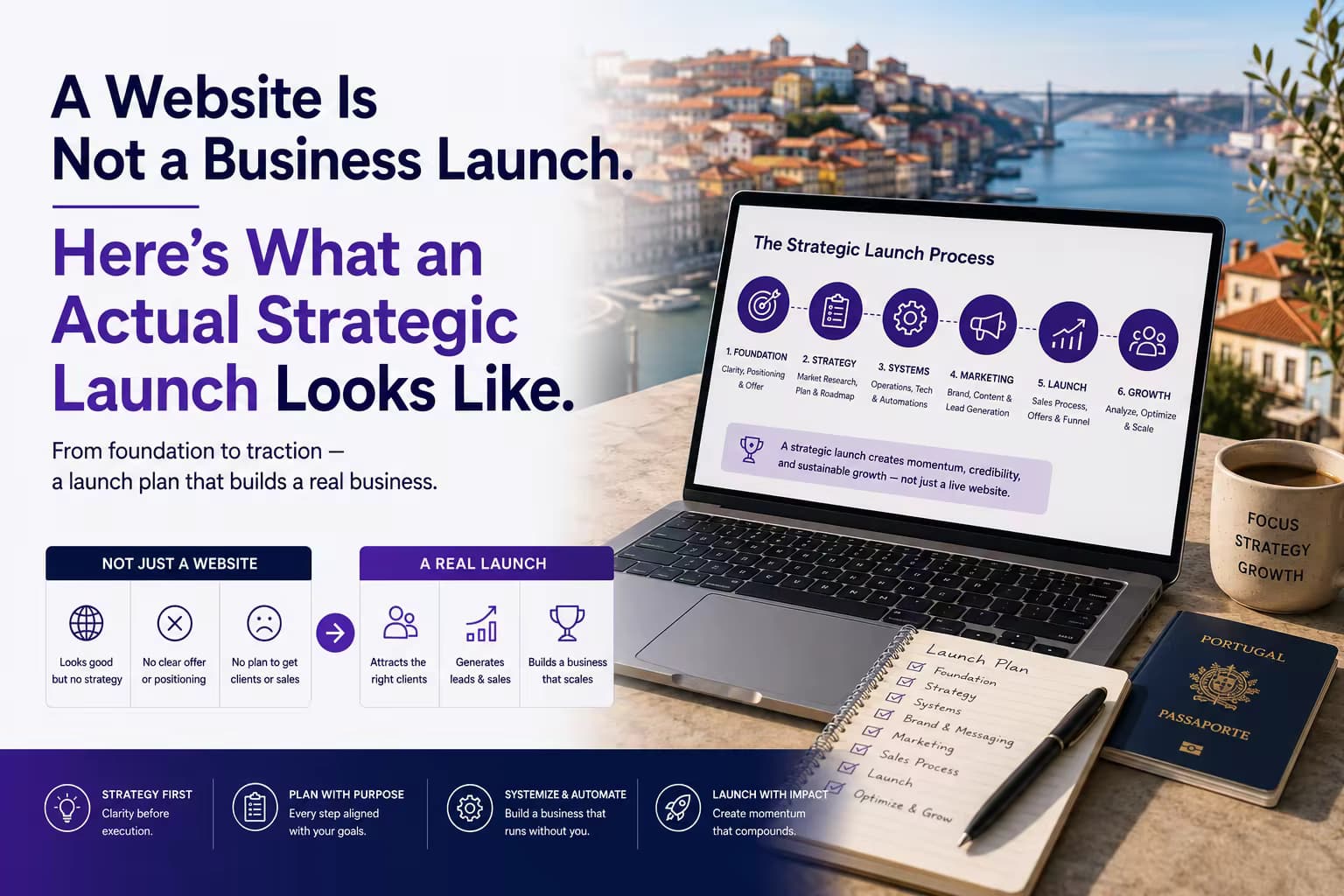
The structure matters. But it should run in parallel with positioning, website setup, Google visibility, and a basic content and marketing foundation. If those are not in place when the legal entity is registered, you are starting behind.
How Arvora Fits In
Arvora works with expat founders at the intersection of strategy, digital presence, and operational foundations. We are not accountants or lawyers — but we work alongside them.
What we do is help you build the commercial layer that sits on top of the legal structure: your positioning, your website, your SEO baseline, your enquiry and booking systems, and the content that makes local clients and international referrals take you seriously.
If you are planning a move to Portugal or have just registered and need to get visible fast, start with a conversation.
Arvora is a consulting-led digital architecture firm based in the Algarve. We help expat founders and international businesses build credible, conversion-ready digital presences in Portugal.
About the author

Moxci
Personal Coach & Growth Partner, Arvora
Moxci brings calm strategic clarity to Arvora client relationships, helping founders and businesses see the bigger picture, make better decisions, and move through growth with focus instead of noise.
Meet the team