This article is part of the Arvora reading room: slower, clearer essays for founders and business owners who want digital decisions to feel less noisy.
Most founders entering Portugal — whether relocating from the UK, Germany, France, or the Netherlands — spend the first few months chasing the wrong problem.
They focus on the website.
Not because the website is unimportant. But because the website is a visible output. It feels like progress. And for a founder managing a relocation, legal setup, tax registration, and the hundred other moving parts of entering a new market, having something they can point at and say "this is the business" provides genuine psychological relief.
The problem is that a website without the strategic foundations underneath it does almost nothing commercially.
This piece explains what those foundations are, why they precede the website rather than following it, and what an actual strategic business launch looks like for an expat founder or international business entering Portugal.
What a Website Cannot Do Alone
A website is a presentation layer. It shows people what you claim to be.
What it cannot do is answer the questions that determine whether someone will contact you:
- Is this business actually relevant to my situation?
- Is this person credible in this specific market?
- Why would I choose them over the alternatives?
- What does working with them actually look like?
- Is the price I'm about to pay going to solve my problem?
These questions are answered by positioning — not design. And positioning is not something you put on a website. It is something you resolve before the website is built, so that every page, every sentence, and every visual choice serves a clear commercial argument.
The Four Foundations That Precede the Website
1. Positioning: Who You Actually Serve and What You Actually Solve
Positioning is the decision to serve a specific type of client with a specific type of problem — and to communicate that decision so clearly that the right prospect immediately recognises themselves in it.
Most expat founders entering Portugal default to generic positioning: "I offer consulting services for businesses." Or "I am a life coach." Or "We provide digital marketing for SMEs."
These descriptions are accurate, but they do not help a buyer self-identify. They also give the business no competitive ground to stand on, because they describe what everyone in the category offers.
Strong positioning sounds different: "I help UK-based founders structure their first business in Portugal — from legal entity selection through to their first client." That is a specific claim about a specific problem for a specific person. A founder reading that knows immediately whether it is for them.
Positioning is the first thing to resolve. Everything else depends on it.
2. Market Intelligence: Who Else Is Solving This Problem, and How
Before investing in a website, a brand, or any marketing assets, a founder needs to understand the competitive landscape in Portugal. This is not just about knowing who the competitors are. It is about understanding:
- How the alternatives are positioning themselves
- Where the market has underserved segments
- What trust signals matter most in this specific category in Portugal
- Whether the target client searches for this service online, and with what keywords
This research takes a day, not a month. But skipping it means building on assumptions. In an unfamiliar market, assumptions are expensive.
3. The Commercial Offer: What the Client Buys and What Happens Next
A complete commercial offer specifies:
- What the client receives (the deliverable or transformation)
- The timeline and process
- The price or price range
- What is included and what is not
- What happens after the engagement
Founders who are clear on this before they launch can communicate it clearly on the website, in conversations, and in proposals. Founders who are not clear on it produce vague websites, hesitant conversations, and proposals that take too long to write.
The website can only reflect clarity that already exists. It cannot create clarity that is not there.
4. Trust Infrastructure: How a New Market Entry Earns Credibility
An expat-led business entering Portugal starts at a credibility disadvantage relative to established local competitors. That disadvantage is not insurmountable — but it requires deliberate attention.
Trust infrastructure includes:
- Case studies or outcome statements that prove the approach works
- Visible expertise through content — articles, guides, or frameworks that demonstrate genuine knowledge
- A Google Business Profile with correct information, a local address (if applicable), and early reviews from clients willing to provide them
- Professional, consistent visual identity that signals permanence, not a trial run
- A clear explanation of how the business operates — process, response times, working arrangements — so that a prospect knows what to expect
Some of these take time to build. Which is why they need to begin before the launch, not after.
What an Actual Strategic Launch Looks Like
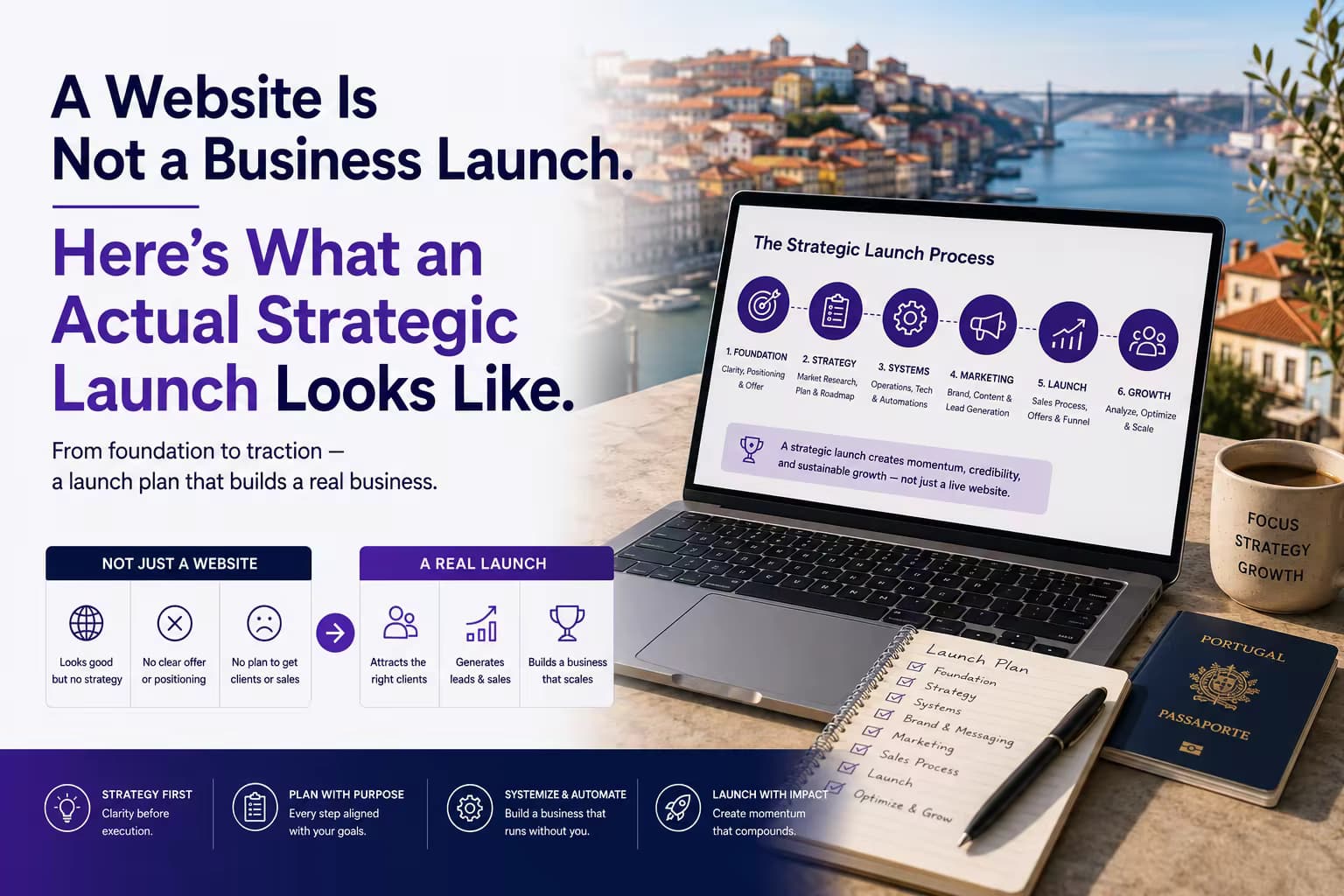
For a founder entering Portugal, a properly structured launch involves:
Weeks 1-2: Foundation work
- Positioning statement drafted, tested, and refined
- Competitive landscape mapped
- Target client profile built with enough specificity to write to them directly
- Commercial offer structured and priced
Weeks 3-4: Asset creation
- Website brief written from the positioning, not the other way around
- Website built with conversion architecture: clear hierarchy, logical flow, contact mechanism that qualifies leads
- Domain, professional email, and Google Business Profile configured
- Two to three pieces of foundational content published that demonstrate expertise in the specific area
Weeks 5-6: Visibility foundations
- Google Search Console configured and sitemap submitted
- Local SEO groundwork laid — correct NAP (name, address, phone) data across directories, initial review generation
- LinkedIn or relevant platform presence aligned with positioning
- Outreach to two to three potential referral sources or complementary businesses
Ongoing: Content and iteration
- Regular content that builds topical authority in the target area
- Regular review of enquiry quality — are the leads converting? If not, which part of the funnel is breaking?
- SEO monitoring and content adjustment as the site accumulates ranking history
This is not a complex programme. A focused founder with the right support can complete the foundational phases in six weeks. What it requires is doing the strategic work first rather than defaulting to the visible output (the website) before the invisible work (the strategy) is done.
Why Most Expat Launches Miss This
The most common pattern is:
- Register the company
- Build a website
- Post on social media
- Wait for enquiries
- Notice that no enquiries are coming
- Spend money on paid advertising without a clear offer or positioning
- Blame the market
The market is not the problem. The foundation is the problem.
Expats moving to Portugal to launch a business are often coming from industries where their reputation preceded them. Referrals came naturally. The website was secondary because the network was primary.
In a new market, that network does not yet exist. The digital presence has to compensate — but only if it is built on strategy rather than aesthetics.
How Arvora Works
Arvora is not a web design agency that builds pages from a brief. We are a consulting-led digital architecture firm that works through the strategic foundations first, then designs and builds the commercial layer that reflects them.
For expat founders entering Portugal, that means:
- Starting with positioning and offer clarity
- Building a website that serves a commercial argument, not just a visual impression
- Laying SEO and trust foundations that compound over time
- Creating content and operational systems that reduce friction and increase visibility
We work with a small number of clients at a time. If you are planning a launch in Portugal or have launched without the strategic layer and are not seeing the results you expected, start with a conversation.
Arvora is a consulting-led digital architecture firm based in the Algarve, Portugal. We help expat founders, international businesses, and premium brands build commercial digital presences that earn trust and generate leads from day one.
About the author

Moxci
Personal Coach & Growth Partner, Arvora
Moxci brings calm strategic clarity to Arvora client relationships, helping founders and businesses see the bigger picture, make better decisions, and move through growth with focus instead of noise.
Meet the team