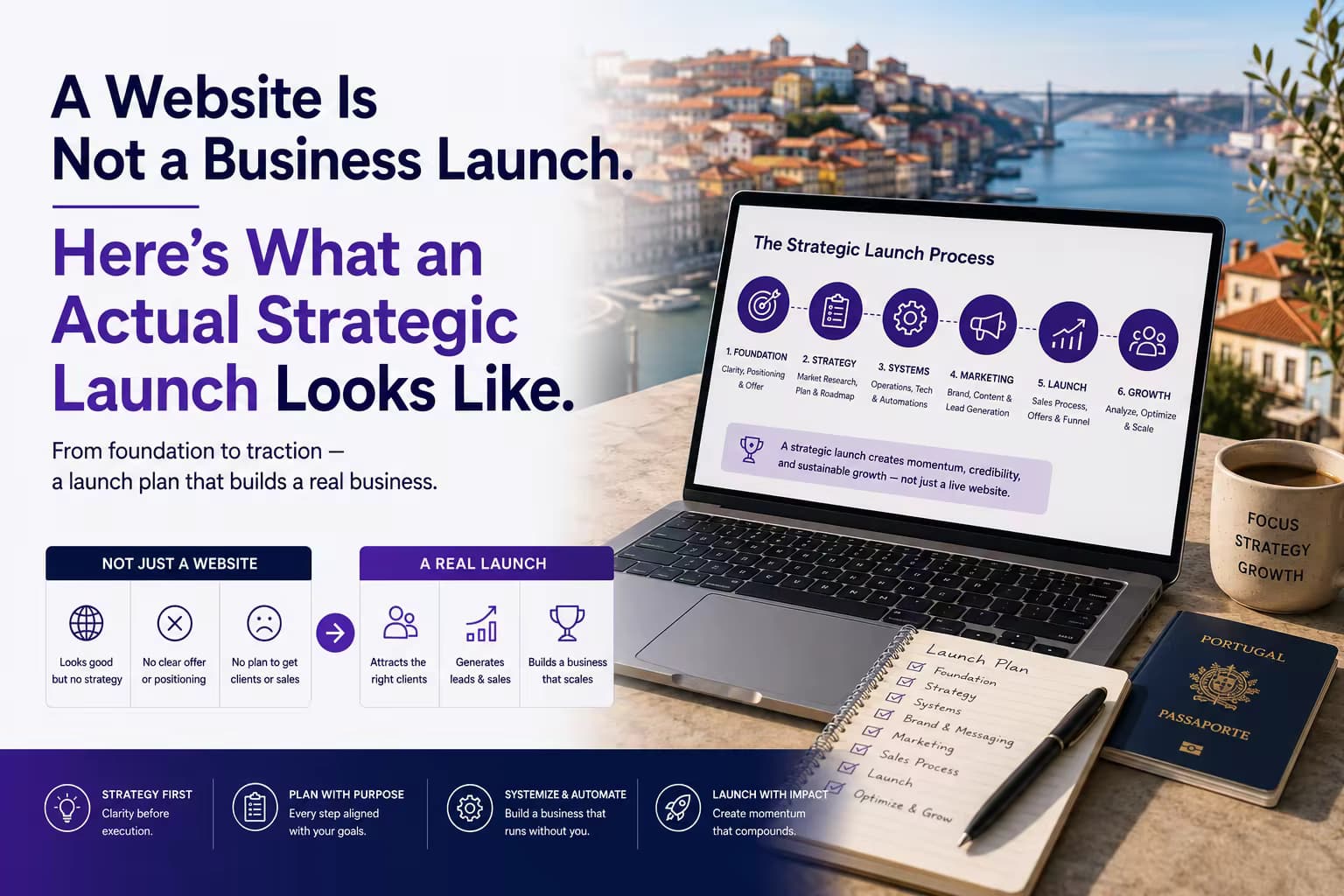
This article is part of the Arvora reading room: slower, clearer essays for founders and business owners who want digital decisions to feel less noisy.
Your business website might be losing you clients before anyone fills out a form, calls your number, or books a meeting. That is not always obvious. A website can look modern, have beautiful images, and still quietly push serious buyers away.
For businesses in the Algarve, this matters even more. Many of your best clients are international founders, relocating families, tourists, investors, or remote business owners comparing options before they ever visit in person. If your website does not build trust quickly, they move on.
Here are the five clearest signs your business website is losing clients, and what to fix first.
1. Visitors Cannot Understand What You Do in Five Seconds
The first job of your website is not to impress people. It is to orient them.
When someone lands on your homepage, they should immediately understand:
- What you offer
- Who it is for
- Where you operate
- Why they should trust you
- What they should do next
If your hero section says something vague like "Building digital experiences for tomorrow" but does not explain the actual service, the visitor has to work too hard. Most will not.
This is especially important for international clients coming into the Algarve. They may be comparing agencies, property services, wellness brands, hospitality businesses, consultants, or local suppliers from another country. They need clarity fast.
What a stronger homepage says
A stronger homepage is direct:
We build high-performance websites and digital products for ambitious businesses, startups, and international founders in the Algarve.
That sentence does not try to sound clever. It gives the reader a reason to stay.
How to fix it
Rewrite your top section so it answers three questions in plain language:
- What do you do?
- Who do you help?
- What outcome do you create?
Then support it with a visible call to action such as "Book a discovery call", "View our work", or "Request a website audit". If people have to scroll, guess, or hunt for the next step, your website is already leaking leads.
2. Your Website Looks Good but Does Not Build Trust
Design matters, but trust converts.
A visually polished website can still feel weak if it lacks proof. A serious client wants to know that you are real, capable, and safe to contact. This is true for local customers, but it is even more true for people moving to Portugal or launching a business from abroad.
Common trust gaps include:
- No clear team or founder information
- No real project examples
- No client results or case studies
- No location signals
- No professional photography
- No clear process
- No privacy policy, terms, or company details
If the site feels anonymous, visitors hesitate.
Why this matters in 2026
Buyers are more careful now. They are used to AI-generated pages, template agencies, fake portfolios, and low-effort service providers. A modern website needs to show enough substance for someone to believe there are real people behind the business.
For Arvora, that means showing the people and thinking behind the work. Druv and Moxci are part of that trust signal: technical execution, growth strategy, and a human partnership model that clients can actually meet and speak with.
How to fix it
Add proof near the places where people make decisions:
- Put testimonials near service sections
- Add case studies near calls to action
- Show founder/team photos on the about page
- Explain your process before asking for a call
- Link to relevant work, results, or examples
- Use real images where possible instead of generic stock visuals
Trust is not one section. It is built across the full journey.
3. Your Website Is Slow or Poor on Mobile
If your website is slow, your business feels slow.
Most people will first visit your website on a phone. They may be in a car, at an airport, between meetings, or walking through town comparing options. If the page loads slowly, shifts around, or makes the contact button hard to tap, they will not wait.
Speed is not just a technical detail. It affects:
- First impressions
- Search visibility
- Form submissions
- Booking rates
- Trust
- Paid ad performance
Google's SEO guidance continues to focus on helpful pages that users can access and understand easily. Fast, mobile-friendly pages help both people and search engines reach the content without friction.
Warning signs to check
Your website may be losing clients on mobile if:
- Images take several seconds to load
- Text is too small to read comfortably
- Buttons are hard to tap
- The menu is confusing
- Contact forms are long or broken
- Popups block the page
- The layout jumps while loading
How to fix it
Start with the pages that make money: homepage, services, contact, booking, product, pricing, and landing pages.
Compress images, remove unnecessary scripts, simplify forms, and make every key action easy on a phone. A website does not need to be visually boring to be fast. It needs to be built with performance in mind from the beginning.
At Arvora, we use modern frameworks like Next.js to build fast websites with clean technical SEO, responsive layouts, and conversion-focused page structure.
4. Your Calls to Action Are Weak, Hidden, or Confusing
A website can lose clients simply because it never clearly asks for the next step.
This usually shows up in three ways:
- The button is too generic: "Learn more"
- The button is buried too far down the page
- There are too many competing actions
If your page has "Contact", "Explore", "Discover", "Read more", "Get started", "Learn more", and "Subscribe" all fighting for attention, the visitor has to decide what matters. That creates hesitation.
Strong calls to action are specific
For a service business, better calls to action might be:
- Book a discovery call
- Request a website audit
- Get a project estimate
- View website packages
- Discuss a startup partnership
For a hospitality or wellness business, they might be:
- Book a table
- Reserve your session
- Check availability
- Plan your stay
- Call the team
The right call to action depends on the page intent. A homepage can invite discovery. A service page should move people toward enquiry. A pricing page should reduce uncertainty. A contact page should make the final step effortless.
How to fix it
Choose one primary action for each page. Repeat it in logical places:
- Near the top
- After key proof points
- At the end of the page
- In the navigation
Also make the action sound useful. "Submit" is weak. "Request a quote" is clearer. "Book a 20-minute discovery call" is stronger again because it tells the visitor exactly what happens next.
5. Your Website Is Not Built Around Search Intent
SEO is not just adding keywords to a page. It is matching what people are searching for with a page that genuinely helps them.
For example, someone searching "website cost Portugal 2026" probably wants pricing, timelines, and comparison guidance. That is why we wrote our guide on website costs in Portugal.
Someone searching "start business Algarve 2026" wants practical setup information, legal basics, and digital launch steps. That is why our guide to starting a business in the Algarve covers the broader business journey.
Someone searching "business website losing clients" is likely asking a different question: "What is wrong with my site, and what should I fix first?"
If every page on your website is only a sales page, you miss those earlier search moments.
Search intent examples
| Search Intent | What the Visitor Wants | Better Page Type |
|---|---|---|
| "web design Algarve" | Compare local website providers | Service page |
| "website cost Portugal" | Understand pricing | Pricing guide |
| "why is my website not getting leads" | Diagnose a problem | Educational blog |
| "startup website Portugal" | Find a launch partner | Startup landing page |
| "best website agency for international clients Algarve" | Shortlist providers | Service + proof page |
Google needs clear signals to understand your content. People need clear structure to trust it. That means your website should use descriptive headings, focused page titles, helpful content, internal links, and pages that answer specific questions.
How to fix it
Build a small content cluster around your commercial services.
For Arvora, that means pages and posts around:
- Website design in the Algarve
- Website pricing in Portugal
- Starting a business in the Algarve
- Startup prototype development
- Product launch strategy
- SEO foundations for local businesses
- AI automations for service companies
Each article should connect naturally to the next. This helps readers keep learning and helps search engines understand that your website has depth around a topic.
The Startup Version: Your Website Is Not Your Product, but It Can Prove Demand
For founders, the problem is slightly different.
You might not need a huge website on day one. You might need a sharp landing page, prototype, waitlist, pitch deck, or MVP that proves people care before you spend heavily on development.
That is where a modern agency should do more than sell pages.
Arvora works with businesses on websites, brand systems, and digital products. For selected startups, we can also explore prototype and launch partnerships where part of the work is structured around equity, revenue share, or a long-term partnership instead of only upfront capital.
This is not for every project. It works when:
- The idea has a clear market
- The founder is serious and available
- There is a realistic launch path
- The product can be validated quickly
- Both sides can define risk and upside honestly
For founders moving to the Algarve or building internationally from Portugal, this kind of partnership can make the difference between waiting for perfect funding and getting a real product in front of users.
Quick Website Audit Checklist
Use this simple checklist to review your own website:
- Can a new visitor understand your offer in five seconds?
- Is your location or market clear?
- Is there a strong call to action above the fold?
- Does the site load quickly on mobile?
- Are your services easy to compare?
- Do you show real proof, people, or work?
- Is your contact path obvious?
- Do your page titles match what people search?
- Do you have helpful content beyond sales pages?
- Does the site make the business feel current in 2026?
If you answered "no" to three or more of these, your website is probably costing you opportunities.
What to Fix First
Do not redesign everything at once unless the website is truly outdated. Start with the highest-impact fixes:
- Rewrite the homepage headline and first section.
- Make the primary call to action obvious.
- Improve mobile speed and layout.
- Add proof: testimonials, team, work, process, results.
- Create or improve one search-focused service page.
- Publish one helpful blog post that answers a real client question.
Small improvements compound. A clearer headline can improve enquiries. A faster contact page can recover lost leads. A better service page can bring in more qualified traffic.
How Arvora Can Help
Arvora is a modern digital agency in the Algarve built for businesses that want more than a brochure website. We help companies and founders create fast, polished, search-ready websites that explain the offer clearly and move visitors toward action.
We are a strong fit if:
- You serve international clients in Portugal
- You are launching a new business in the Algarve
- Your current website looks fine but does not generate leads
- You need a startup landing page, prototype, or MVP
- You want a practical partner, not a slow agency process
- You care about design, speed, SEO, and conversion together
The goal is simple: your website should not just exist. It should help people find you, trust you, and choose you.
If your website is losing clients, the best time to fix it is before your next serious visitor leaves.
FAQ
How do I know if my website is losing clients?
The clearest signals: visitors arrive but do not contact you, page speed is slow on mobile, the homepage does not explain the offer in one scan, contact details are buried, and the design looks dated compared to competitors. A quick self-audit using the checklist above is a good starting point.
What is the most common reason business websites do not generate enquiries?
The most common cause is unclear messaging — the visitor cannot immediately understand what the business does, who it is for, or what to do next. This is a positioning and structure problem, not a design problem. Even a visually polished site fails if the offer is unclear.
Is it worth redesigning a website that looks fine but does not convert?
Sometimes yes. A site that looks acceptable but loads slowly, ranks poorly, or fails to convert visitors is underperforming regardless of how it looks. A targeted fix — rewriting the homepage, improving speed, clarifying the offer — is often more cost-effective than a full rebuild.
How much does it cost to fix a business website in Portugal?
Targeted improvements typically cost €500–1,500. A full redesign in Portugal ranges from €2,000–€8,000 depending on the number of pages and complexity. See the website cost guide for Portugal for a detailed breakdown.
Which agency in Portugal can help fix a poor-performing website?
Arvora is a consultant-led agency in the Algarve that specialises in websites built for trust and conversion. The website redesign service is specifically for businesses that have outgrown their current site.
Should I rebuild or just update my existing site?
Update if the underlying structure, platform, and SEO are solid and only specific elements are underperforming. Rebuild if the platform is outdated, the site is slow, the URL structure needs to change, or the business has moved significantly past where the original site was designed to support.
This guide was written by Druv at Arvora — a digital agency in the Algarve helping businesses, founders, and international entrepreneurs build websites and digital products that turn attention into action. Last updated June 2026.
About the author
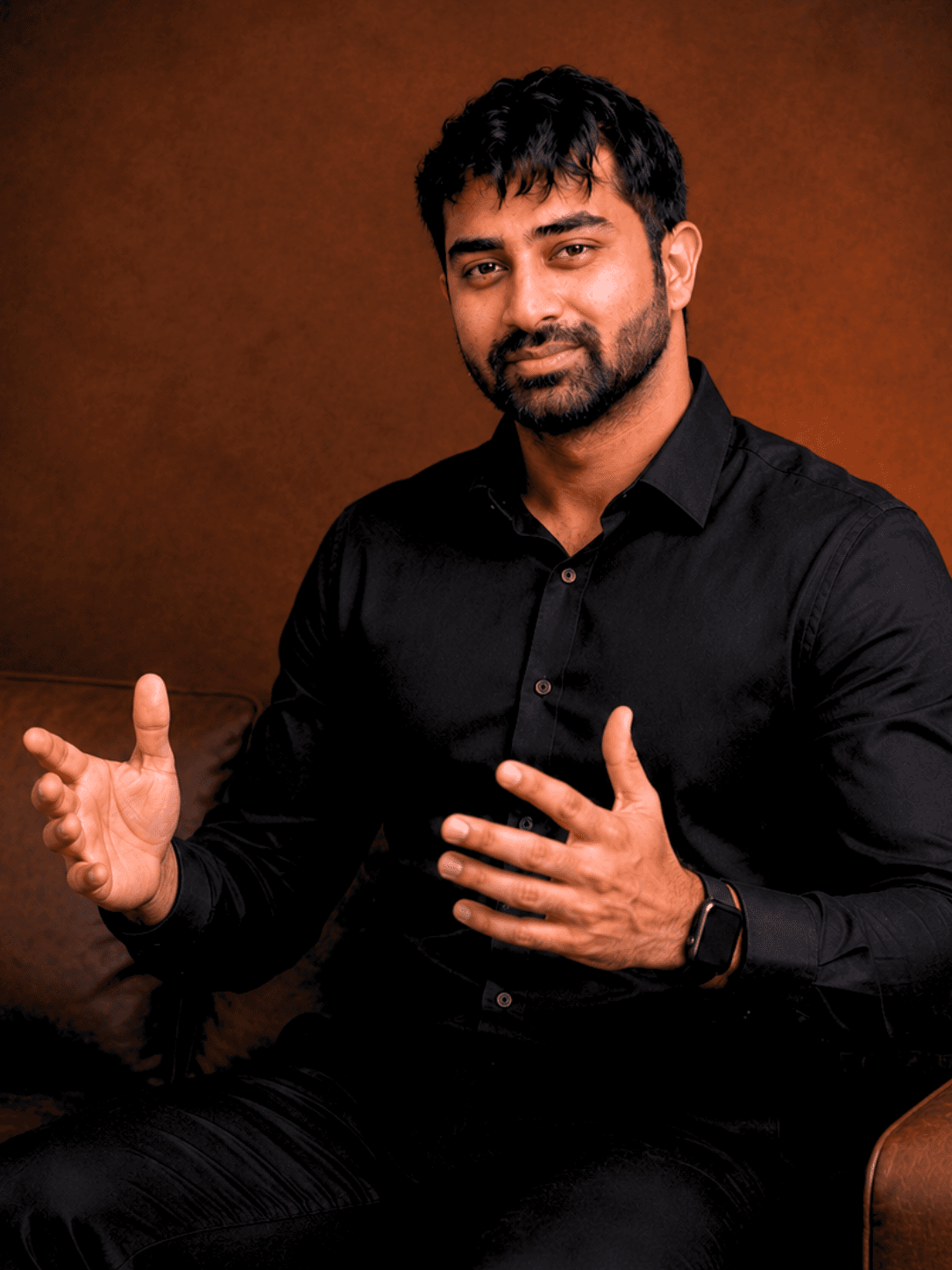
Druv
Digital Ecosystem Architect, Arvora
Druv leads the technical and creative architecture at Arvora — connecting websites, automation, AI workflows, and digital infrastructure into clear systems built for long-term business growth.
Meet the team